
Key Takeaways
- DIY water extraction removes surface water but leaves hidden moisture trapped behind walls, under flooring, and inside insulation.
- Mold can start growing within 24 to 48 hours in damp environments, leading to health risks and expensive remediation costs.
- Consumer-grade wet/dry vacuums remove 1–3 gallons per minute, and commercial truck-mounted extractors remove 30 to 60 gallons per minute.
- Technicians certified by the Institute of Inspection, Cleaning and Restoration Certification (IICRC) use low-grain refrigerant (LGR) dehumidifiers, thermal imaging cameras, and moisture meters to verify complete structural drying.
- Improper DIY cleanup can jeopardize insurance claims by failing to provide professional moisture documentation and drying logs.
Water damage from a burst pipe, an appliance malfunction, or storm flooding is highly stressful for homeowners. The immediate instinct is to grab a shop vacuum and a stack of towels to start cleaning up and avoid the cost of calling a professional. That reaction makes sense, but it’s also where most water damage situations escalate.
Removing only visible water doesn’t make a property dry, as moisture travels deep into building materials, wall cavities, subfloors, and insulation long before the surface appears wet. By the time mopping is done, the water has already seeped into places no shop vacuum can reach.
For safe and effective water removal, many property owners in Oklahoma City and the surrounding areas turn to OKC Restorations, a locally owned, family-operated business. Our experienced technicians use commercial-grade equipment and industry-standard drying protocols to prevent hidden moisture, mold growth, and structural decay. We treat every home like our own, and our goal is to make sure your property is protected for the long term.
Why DIY Water Extraction Often Fails
Surface water and absorbed moisture need completely different approaches. Removing the water you can see is the easy part, but the water you can’t see causes lasting damage.
Household Equipment Isn’t Designed for Major Water Removal
Wet/dry vacuums, box fans, and residential dehumidifiers are built for everyday household tasks. They aren’t engineered to handle major water intrusions. The two metrics that matter most in water extraction are cubic feet per minute (CFM) airflow and water lift (suction power). Consumer-grade shop vacuums typically generate 50–100 CFM and limited suction depth. This is enough to pick up spilled liquids, but not to pull moisture out of carpets, drywall, or subfloors.
Professional equipment operates at a categorically different level. Truck-mounted extractors, commercial air movers, and high-efficiency particulate air (HEPA) filtration systems are designed specifically for structural drying. A shop vacuum might remove a few gallons of water from a carpet’s surface, but the padding underneath, the subfloor, and the nearby wall framing will stay saturated. That trapped moisture leads to the secondary damage that costs homeowners much more than the original cleanup would have.
Hidden Moisture Can Cause Long-Term Structural Damage
Damage behind walls is one of the most common and costly outcomes of incomplete water extraction. Moisture doesn’t just stay where it lands. It wicks upward through baseboards, travels laterally through insulation, and seeps downward through subfloor assemblies. Drywall absorbs water like a sponge and begins to degrade within days. Hardwood flooring buckles and warps as moisture content rises. Wood framing softens and rots over weeks and months.
Hidden moisture problems frequently go undetected until the home’s structural integrity is already compromised. Warped flooring, rotting floor joists, and ceiling collapse are predictable results of unaddressed water damage. Failures of this kind often call for extensive demolition and reconstruction. This turns what was originally a manageable water leak into a major renovation project that could have been avoided entirely.
Mold Can Begin Growing Within 24–48 Hours
Mold spores are present in almost every indoor environment. Under dry conditions, they remain dormant, but introduce moisture, and the biological timeline accelerates quickly. According to the IICRC S500 Standard for Professional Water Damage Restoration, drying must begin strictly within 24 to 48 hours to prevent mold growth and structural deterioration.
Once mold colonies establish themselves inside walls or under flooring, the consequences for air quality are significant. Spores become airborne, triggering respiratory issues, allergic reactions, and odors that permeate the entire structure. Professional mold remediation is much more expensive than immediate water extraction. IICRC-certified technicians follow strict industry drying standards to prevent this secondary damage from occurring in the first place.
The Biggest Risks of DIY Water Removal
Incomplete extraction carries risks that go well beyond a damp floor, but property owners who attempt DIY cleanup often underestimate the specific safety and financial hazards.
Electrical Safety Hazards
A flooded building often features the dangerous combination of water and electricity. Standing water near outlets, damaged wiring, and submerged appliances present a severe risk of electrocution. What many homeowners don’t realize is that even after the power has been cut at the breaker, a generator running nearby or back-fed electricity from a neighboring property can still energize a flooded circuit. Buzzing or sparking wires in a water-damaged area are a warning sign that electrical current is present.
Professional restoration technicians inspect for electrical hazards before they begin water extraction. They work with the property’s electrical system to confirm that the affected areas are safe to enter and operate equipment in. Attempting this inspection without proper training is a risk that no amount of money saved on cleanup is worth taking.
Contaminated Water Exposure
Not all water damage involves clean water. The IICRC classifies water damage into three categories based on contamination level. Category 1 is clean water from sanitary sources like broken supply lines. Category 2, or gray water, contains contaminants from sources like washing machines or dishwashers. Category 3, or black water, is highly contaminated and may contain sewage bacteria, pathogens, or biohazards.
Water category also changes over time. Clean water that sits for more than 48 hours transitions to gray water as bacteria multiply, but floodwater from storms or sewage backups is immediately classified as black water, no matter how it looks. In addition, cleaning up Category 2 or Category 3 water without proper personal protective equipment (PPE) and sanitization protocols exposes homeowners to serious illness. Commercial restoration teams use the specialized gear and Environmental Protection Agency (EPA)-registered antimicrobial treatments required to handle contaminated water safely.
Insurance Claim Problems
DIY cleanup can lead to a financial risk that many homeowners don’t think about until it’s too late. Insurance policies usually ask for evidence of professional mitigation for water damage claims. Insurers use calibrated moisture meters, material assessments, and drying logs to determine whether damage is new or the result of long-term exposure. Without professional documentation, claims are frequently denied or reduced.
Beyond documentation, DIY attempts can actively worsen the damage. Using fans without dehumidification, not removing saturated materials, or missing hidden moisture pockets all create conditions that insurers may classify as a failure to mitigate. That classification can result in outright claim denial. Experienced water removal companies provide the evidence that follows IICRC S500 standards so that insurers get what they need to process a valid claim.
Why Commercial-Grade Water Extraction Equipment Matters
Proper drying involves simultaneously managing vapor pressure, relative humidity, airflow, and material saturation. The performance gap between commercial and consumer tools is significant, but professional water damage restoration companies invest in equipment specifically engineered for this process.
Industrial Water Extractors Remove Water Faster
Truck-mounted extraction units, submersible pumps, and high-powered portable extractors remove water at rates that consumer equipment can’t hope to approach. Professional extractors can remove 30–60 gallons of water per minute, compared to a consumer-grade shop vacuum at 1–3 gallons per minute. That difference directly determines how much water soaks into building materials before extraction is complete.
Faster removal reduces saturation, which shortens drying time, lowers the risk of mold growth, and limits secondary structural damage. Weighted extraction tools press deep into carpet, pulling water from the padding underneath rather than just the surface fibers. For basement floods or commercial spaces, truck-mounted systems extract water directly into holding tanks, eliminating the need to stop and empty buckets.
Commercial Dehumidifiers Prevent Hidden Moisture
Extraction removes standing water, but the moisture that has soaked into materials needs dehumidification. Skip this step, and mold will follow. Professional LGR dehumidifiers are the workhorses of structural drying, as they can remove 200 or more pints of water per day from the air and the surrounding materials. A standard residential dehumidifier can handle 30 to 50 pints per day at best, and it loses effectiveness as humidity drops below 40%.
LGR dehumidifiers continue pulling moisture from the air even in low-humidity environments, creating the vapor pressure differential needed to draw water out of drywall, insulation, and wood framing. The drier the air, the faster saturated materials release trapped moisture, creating an accelerating drying cycle throughout the affected area.
Air Movers Create Proper Drying Conditions
Pointing a standard box fan at a wet wall doesn’t dry it. Without dehumidification to capture the evaporated moisture, fans simply move humid air around the room, potentially spreading mold spores and increasing indoor humidity levels. Professional drying requires a coordinated system of air movement and moisture removal working together.
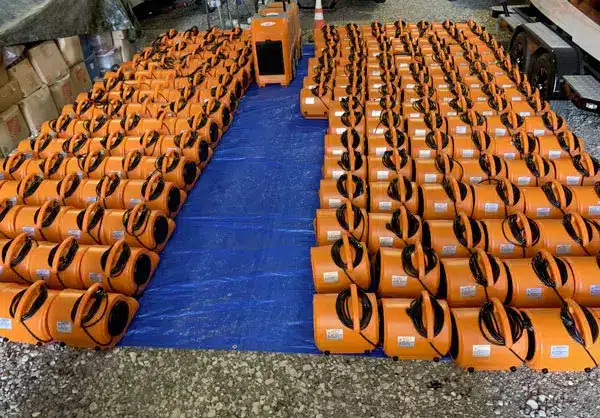
That’s where air movers come in. They work with dehumidifiers to speed up evaporation, directing high-velocity airflow across wet surfaces at specific angles (typically 45 degrees) toward walls and floors. A water-damaged room normally requires three or four strategically placed air movers for maximum effectiveness.
Moisture Detection Technology Finds What You Can’t See
Moisture inside wall cavities, under flooring, and within subfloor assemblies often remains completely undetected without devices that determine how far moisture has spread. Thermal imaging cameras detect temperature differences that indicate hidden moisture pockets behind walls and under floors. Penetrating moisture meters measure the moisture content inside wood and drywall, and non-penetrating meters scan surfaces without causing damage. Hygrometers monitor ambient humidity levels throughout the drying process.
Together, these tools allow professionals to create accurate moisture maps of the affected area, verify that drying is progressing correctly, and confirm when materials have reached safe moisture levels.
Common DIY Water Extraction Mistakes
Homeowners who try to conduct water damage cleanup themselves usually make the same errors repeatedly. Each mistake compounds the original problem and increases the final cost of restoration.
Waiting Too Long to Start Cleanup
Water damage gets worse quickly, and the timeline is unforgiving. Within 24 hours, moisture spreads deeply into building materials and begins degrading drywall. By 48 hours, mold risk increases significantly, and gray water changes to black water. After several days, severe structural deterioration begins in wood framing and subfloors. Every hour of delay allows water to travel further into the building and cause more damage.
Not Removing Wet Materials
Carpet padding, insulation, drywall, and baseboards act like sponges. Once saturated, they hold moisture for days or weeks, creating a constant source of humidity inside the wall or the floor. Trapped moisture in these porous materials spreads and creates ideal conditions for mold growth. Reputable water removal companies assess which materials can be dried in place and which must be removed to protect the surrounding structure.
Using Fans Incorrectly
Standard fans without commercial dehumidification can make water damage worse. Fans alone increase indoor humidity by evaporating surface moisture without trapping it, and this humid air can spread mold or contaminants throughout the house. Professional drying requires a cohesive strategy: air movers accelerate evaporation, and LGR dehumidifiers capture the moisture before it moves to unaffected areas.
Assuming the Area “Feels Dry”
Touch isn’t a reliable moisture detection method. Drywall can feel dry on the surface but still hold a lot of moisture inside the paper facing and gypsum core. Hardwood flooring can also appear flat and dry while the subfloor is saturated. Moisture inside wall cavities, under flooring, and within subfloors often stays completely undetected without specialized moisture mapping equipment. Leaving hidden moisture behind is one of the most common and costly DIY restoration failures.
When You Should Call a Professional Water Restoration Company
Certain situations make DIY cleanup inadvisable and genuinely dangerous. Immediate professional intervention is necessary in the following scenarios.
Large flooding events from burst mains or natural disasters involve water volumes and contamination levels that exceed any consumer equipment’s capability. Sewage backups are classified as Category 3 black water and require specialized PPE, containment protocols, and EPA-registered sanitization treatments. Storm damage and roof leaks introduce water from above, saturating ceilings, insulation, and walls in ways that are difficult to detect without thermal imaging.
Commercial property water damage affects large areas and high-voltage electrical systems, resulting in greater liability than residential losses. Water damage on ceilings, hardwood floors, crawl spaces, basements, and electrical systems requires the diagnostic tools and extraction capacity that only professional equipment can provide.
The Professional Water Extraction Process
To make sure that nothing is missed, our IICRC-certified technicians follow a comprehensive, systematic five-step restoration process on every job.
- Inspection and moisture assessment: Using thermal imaging cameras and calibrated moisture meters to map the full extent of the damage, including moisture in walls and subfloors.
- Emergency water removal: Deploying truck-mounted extractors and submersible pumps for rapid bulk water removal.
- Drying and dehumidification: Positioning heavy-duty air movers and LGR dehumidifiers to pull moisture and to accelerate drying.
- Cleaning and sanitizing: Applying antimicrobial treatments and HEPA filtration to eliminate bacteria, mold, and contaminants.
- Restoration and repairs: Returning the property to its original condition, including drywall replacement, flooring repair, and any necessary structural work.
DIY vs. Professional Water Extraction Comparison
| Factor | DIY Cleanup | Professional Water Extraction |
|---|---|---|
| Equipment power | Limited (shop vacs, box fans) | Commercial-grade (truck-mounted, LGR dehumidifiers) |
| Hidden moisture detection | Usually none (relies on touch, unreliable) | Advanced moisture mapping (thermal imaging, meters) |
| Drying speed | Slow and incomplete | Rapid structural drying |
| Mold prevention | Inconsistent (high risk of growth) | Industry-standard drying protocols |
| Insurance documentation | Limited or non-existent | Professional reporting and moisture logs |
| Safety procedures | Minimal (risk of contamination) | IICRC-certified mitigation protocols and PPE |
| Long-term protection | Uncertain (risk of secondary damage) | Verified, scientifically proven drying process |
How Fast Action Can Save on Repair Costs
The financial case for immediate professional intervention is straightforward. Rapid extraction reduces the scope of mold remediation, prevents structural repairs, saves flooring from replacement, and minimizes business interruption for commercial properties. Mold remediation alone can cost several times more than removing water in the first place would have. Replacing warped hardwood floors or rotted subfloor assemblies adds expenses numbering in thousands of dollars.
Fast action also protects the health and safety of everyone in the building. Mold exposure causes respiratory issues, allergic reactions, and long-term health problems. Structural failures from unresolved moisture damage can create physical hazards, such as uneven, warped floors. Safeguarding property value and indoor air quality starts with calling a professional before the damage has time to spread.
Why Choose OKC Restorations for Water Extraction Service
OKC Restorations has a wealth of local industry experience and dedication to our community. We are not a franchise. We are your neighbors, and our goal is to make sure your home and business are safe.
Our skilled team members are available 24/7 for emergency response, bringing commercial-grade extraction equipment and advanced moisture detection tools to every job. We specialize in finding and eliminating hidden moisture before it becomes a mold problem. Free estimates are available, and financing through Wisetack makes professional restoration accessible when you need it most. We are licensed, bonded, and insured, and our 4.9-star Google rating reflects the care we bring to every property we restore.
Protect Your Investment with Professional Help
DIY water extraction may seem cheap at first, but it almost always leads to mold, structural damage, recurring moisture, and much more expensive and disruptive repairs down the road. Professional-grade equipment ensures complete drying, faster mitigation, safer restoration, and long-term protection for your property and your family.
After any flooding or water intrusion event, contact OKC Restorations for an immediate professional inspection. Our team is ready to respond around the clock, and we will handle everything from initial extraction to final restoration so you can focus on getting your life back on track.
Frequently Asked Questions (FAQs)
About Author


HomeAdvisor uses an extensive screening process to screen businesses and business owners/principals.


Contact